B2B marketing often starts with who a buyer is: their job title, industry, company size, revenue, or technology stack. Those signals help define a good-fit prospect, but they do not tell you whether that company is actually researching a solution today.
Intent-based marketing adds that missing layer.
Instead of treating every account that fits your ideal customer profile as equally valuable, intent-based marketing looks at behavioral signals that indicate active research. These signals can come from your own website and channels, partner platforms, review sites, or broader B2B web activity.
Used properly, intent data helps marketing and sales decide which accounts deserve attention, what they may be researching, and when outreach is more relevant.
What Is Intent Data?
Intent data is behavioral information that indicates an account or buyer may be researching a particular problem, product, service, or solution.
For example, imagine a marketing director who repeatedly searches for marketing analytics software, reads comparison content, visits vendor websites, and downloads a guide about dashboard implementation. Those individual actions do not prove that a purchase is imminent. Together, however, they create a stronger buying signal than company demographics alone.
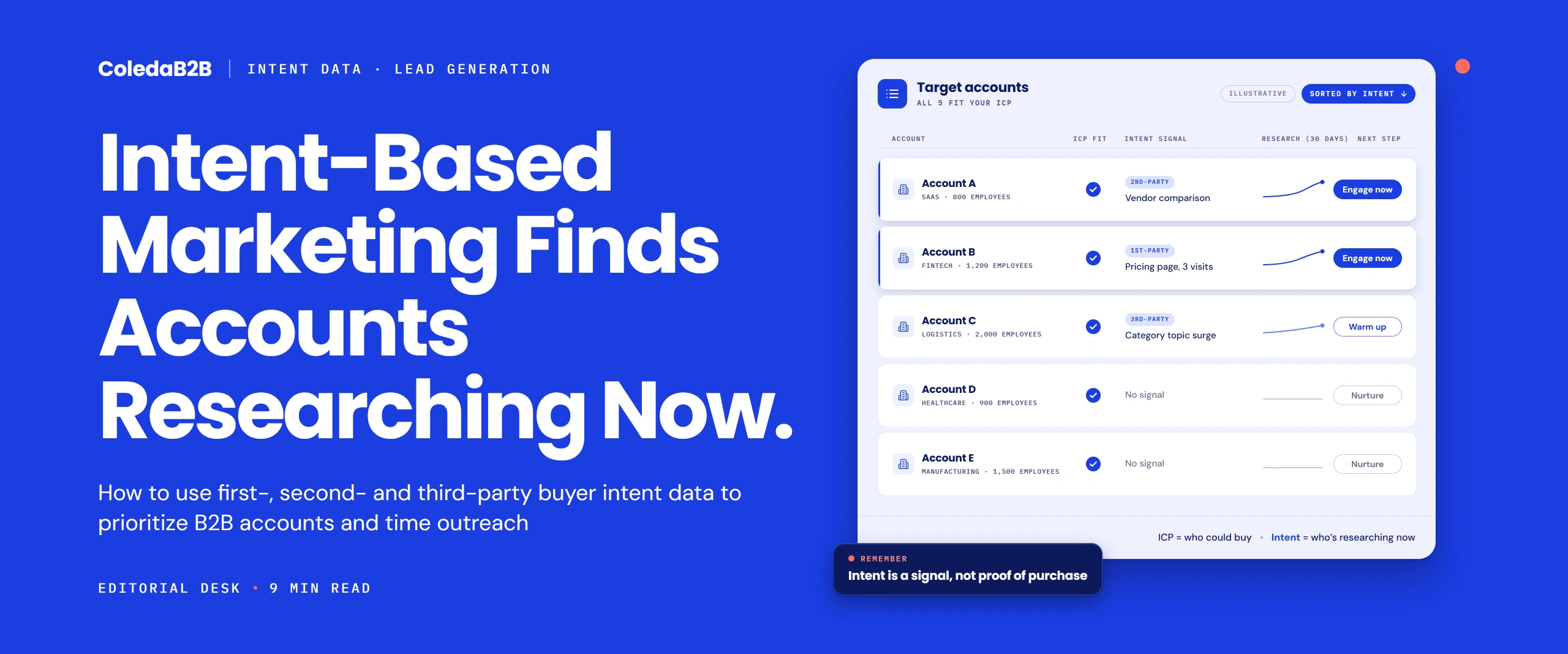
That distinction matters. Intent is a signal, not proof of purchase. Strong B2B teams combine intent with account fit, engagement, CRM information, buying-group data, and other business signals before deciding how to act.
This is what makes intent-based marketing useful. It does not replace your ICP or lead-scoring model. It adds behavioral context that can help your team prioritize accounts already showing signs of active research.
The Three Types of Intent Data
Intent data is commonly discussed in three categories: first-party, second-party, and third-party intent data. Each provides a different view of buyer behavior.
First-Party Intent Data
First-party intent data comes directly from your own digital properties and systems.
Typical signals include website visits, product or pricing-page views, content downloads, form submissions, email engagement, webinar registrations, and CRM or marketing automation activity. Because these actions happen within your own ecosystem, they provide direct evidence that someone has interacted with your brand.
The limitation is reach. First-party data can tell you what known or identifiable visitors are doing on your properties, but it cannot show you every company researching your category elsewhere.
That makes first-party intent particularly valuable for identifying depth of engagement once an account has entered your orbit.
Second-Party Intent Data
Second-party intent data is information another organization has collected through its own first-party interactions and makes available through a partnership, integration, or data arrangement.
A common example is buyer activity on software review platforms. Research activity on platforms such as G2 or TrustRadius can provide signals that a company is evaluating a category, vendor, or competing solution.
Second-party data can be useful because it adds context that your own website cannot provide. A buyer may never visit your site while actively researching your category on a review or comparison platform.
Third-Party Intent Data
Third-party intent data comes from external sources that aggregate research activity across a broader network of websites, publishers, platforms, or other digital properties.
This can reveal accounts researching your category before they interact with your brand directly. Providers use different data sources and methodologies, so coverage, identity resolution, topic depth, privacy practices, and signal quality can vary significantly between vendors.
For that reason, buying the largest volume of intent data is not necessarily the goal. What matters is whether the signals are relevant to your market and actionable for your sales and marketing teams.
How Intent-Based Marketing Works in Practice
Intent data becomes valuable when it changes what your team does.
Suppose your ICP contains 1,000 target accounts. Firmographic data may tell you that 300 are a strong fit. Intent data can add another layer by showing which of those accounts are actively researching topics connected to your offering.
That can change the order in which marketing and sales engage them.
A practical workflow looks like this:
Identify → Enrich → Detect → Prioritize → Personalize → Measure
First, define the accounts that fit your ICP. Then enrich those accounts with relevant firmographic, technographic, and contact information. Next, monitor intent signals and identify accounts showing meaningful research activity.
From there, prioritize accounts using intent alongside fit and engagement. Marketing can adjust content, advertising, and nurture activity, while sales can use the available context to make outreach more relevant.
Finally, measure what happened. Look beyond clicks and engagement to account progression, sales conversations, opportunities, pipeline, and revenue.
Where B2B Teams Can Use Intent Signals
Intent data can influence several parts of a B2B demand-generation program.
Content and messaging: If an account is researching a specific problem, content can be aligned with that problem rather than relying on generic industry messaging.
Paid advertising: Intent signals can help focus campaigns on accounts showing relevant research behavior instead of treating every account in the ICP equally.
Sales outreach: Sales teams can use account-level intent topics as context for deciding which accounts to contact and what conversation may be relevant.
Lead and account prioritization: Intent can become another input into scoring models, helping teams distinguish between a good-fit account and a good-fit account that is currently active.
Nurture programs: Different levels of research activity can support different content journeys. Early research may call for educational material, while active vendor comparison may call for proof, differentiation, or implementation information.
ABM activation: Intent can help identify which target accounts deserve more immediate attention within an account-based marketing program.
The important point is that intent should trigger an action, not simply populate another dashboard.
Why Intent-Based Marketing Matters
It Helps Find Demand Earlier
Traditional lead generation often waits for a visible conversion such as a form fill, demo request, or sales inquiry.
Intent signals can provide visibility earlier in the research process. An account may be actively evaluating a category without ever visiting your website or submitting a form. Third-party and second-party signals can help bring some of that otherwise hidden research activity into view.
It Makes Prioritization More Precise
A strong ICP tells you who could buy.
Intent data adds context about who may be researching now.
That distinction can help marketing and sales allocate time more intelligently. Rather than giving the same level of attention to every qualified account, teams can use current behavioral signals to identify accounts that warrant closer attention.
It Improves Outreach Context
Intent data is most useful when it gives a salesperson something meaningful to work with.
Knowing that an account is researching “marketing automation” is more useful when that information can be combined with the account’s industry, existing technology, business situation, relevant stakeholders, and previous engagement.
The result should not be a generic email containing the detected keyword. It should be a better-informed reason to start a conversation.
It Connects Marketing and Sales Around the Same Signal
Marketing may see content engagement while sales sees prospect activity. Intent data can provide another shared layer of account context.
When both teams agree on what constitutes a meaningful signal and what action should follow, intent becomes part of the revenue process rather than another marketing metric.
It Can Reduce Wasted Effort
Sales and marketing resources are limited. If a team can identify accounts showing relevant research behavior, it can concentrate effort where there is stronger evidence of current interest.
That does not mean ignoring the rest of the market. It means using available signals to make prioritization more deliberate.
Intent Data and Account-Based Marketing
Intent data and ABM work well together because they answer different questions.
ABM defines the accounts worth pursuing. Intent helps identify which of those accounts may be active right now.
Consider a target-account list containing 500 companies. All 500 may fit your ICP, but they are unlikely to be at the same point in the buying journey at the same time.
Intent signals can help identify accounts researching relevant topics, comparing vendors, or showing increased activity. Marketing can then adjust campaigns and content, while sales can prioritize outreach where the combined evidence supports action.
The strongest approach is not to let intent replace account selection. Instead, layer intent onto fit, engagement, timing, and buying-group context.
Intent Data Providers to Evaluate
The intent-data market continues to evolve, so provider capabilities should be checked before each technology purchase rather than relying on an old vendor list.
As of 2026, providers and platforms with active intent-data capabilities include:
- Demandbase: B2B buyer intent within its account-intelligence and GTM ecosystem, with signals covering category and competitor research.
- 6sense: Intent and predictive intelligence combining first-party, third-party, CRM, and other account signals.
- Leadfeeder: Website visitor intelligence with intent scoring based on factors such as visit quality, recency, frequency, and visitor activity.
- UpLead: Intent data for identifying prospects showing relevant buying behavior and prioritizing outreach.
- Bombora: B2B intent data based on research activity across its Data Co-op and related signals.
- RollWorks / AdRoll ABM: Intent capabilities that include proprietary keyword intent alongside sources such as Bombora and G2.
- ZoomInfo: Buyer and account intelligence capabilities that include intent-related signals and can be evaluated as part of a broader B2B data stack.
The right provider depends on your market, target-account coverage, data requirements, CRM environment, geography, privacy requirements, and the actions your sales and marketing teams need to take from the signal.
A larger dataset is not automatically a better fit.
How to Evaluate an Intent Data Provider
Before signing a contract, test the data against your actual market.
Start with coverage. Do the provider’s signals meaningfully cover your target industries, company sizes, regions, and accounts?
Next, examine signal quality. Can you understand what the account is researching, how recent the activity is, and whether the signal is strong enough to justify action?
Then check identity resolution. Can the platform reliably connect activity to the right company or account? This matters because an inaccurate account match can turn a useful signal into misleading outreach.
Finally, test activation. Can the data flow into the CRM, advertising platform, marketing automation system, or sales workflow your team already uses?
A useful test is simple: give a sales representative a small set of intent-qualified accounts and ask what they would actually do with the information.
If the answer is unclear, the problem may not be the data. The workflow may need to be fixed first.
The Most Common Intent Data Mistake
The biggest mistake is treating every intent signal as a buying signal.
Someone reading an article about your category may be learning. Someone researching competitors may be evaluating. Someone repeatedly visiting pricing pages may be much closer to a commercial decision.
Those behaviors should not be treated as equivalent.
Intent works better when signals are interpreted in context. Recency, frequency, topic relevance, account fit, engagement depth, and the number of people involved can all change the meaning of an activity pattern. Modern intent platforms increasingly combine multiple signals rather than relying on one isolated behavior.
The goal is not to find a magical score that says “buy now.”
The goal is to build enough evidence to make a better decision about where to focus, what to say, and when to engage.
The Bottom Line
Intent-based marketing gives B2B teams a more useful view of demand because it adds behavioral context to traditional account and lead data.
Your ICP tells you which companies fit.
First-party engagement tells you how those companies interact with your brand.
Second-party and third-party intent can reveal research happening beyond your own properties.
When these signals are combined with sales and marketing context, teams can prioritize accounts more intelligently and create more relevant engagement.
The value of intent data is not the number of signals a platform can collect. It is what your team can understand, act on, and connect to pipeline.
FAQs:
Intent data is behavioral information that indicates an account or buyer may be researching a particular problem, product, service, or solution. Common signals include content consumption, website activity, searches, review-site research, and other digital behaviors.
First-party intent comes from your own digital properties and systems. Second-party intent comes from another organization’s first-party data shared through a partnership or data arrangement. Third-party intent is aggregated from external sources across a broader network of websites and platforms.
Intent data can help ABM teams identify which target accounts are showing relevant research activity. This allows marketing and sales to prioritize accounts based on both fit and current behavior instead of treating every target account with equal urgency.
No. Intent is a signal, not proof of purchase. It becomes more useful when combined with account fit, engagement, CRM information, buying-group context, and other relevant signals.
Buyer intent signals are observable behaviors that may indicate active research or increased interest in a product, service, problem, or category. Examples include repeated content consumption, relevant searches, pricing-page visits, competitor research, review-site activity, and increased engagement from multiple people at an account.
There is no universal choice. Evaluate providers based on account coverage, signal quality, identity resolution, geographic reach, privacy practices, integrations, and how easily your sales and marketing teams can turn the data into action.