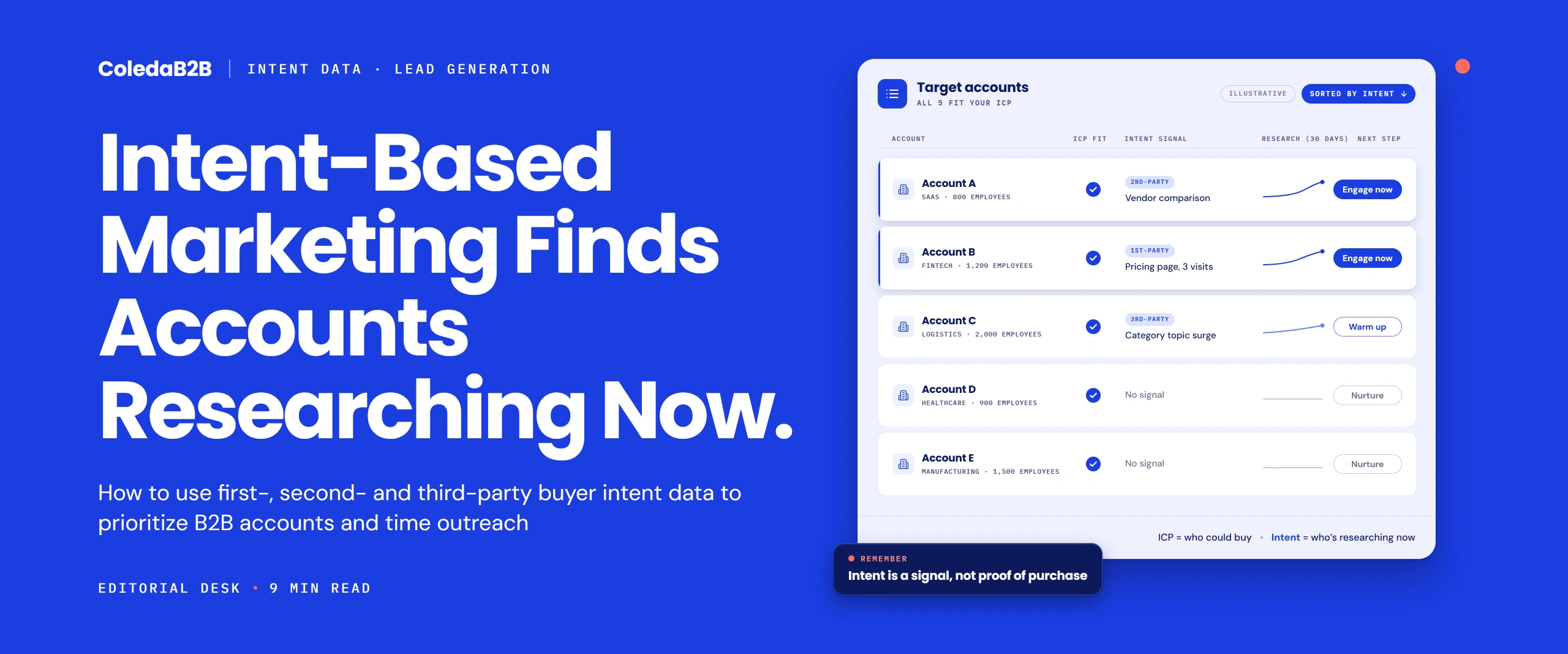
Two SDRs start the quarter with different lists. One gets 500 accounts “surging” on a topic from a third-party provider. The other gets 40 accounts that visited the pricing page last week.
The first list is bigger and earlier. The second is smaller and warmer. Which one produces more pipeline?
Usually, neither on its own. The real value of first-party vs third-party intent data comes from understanding what each can see, where each goes blind, and how to use them together.
The Three Types, in Plain Terms
- First-party intent data comes from your own channels: website visits, content downloads, email clicks, webinar attendance, and product usage.
- Second-party intent data is another company’s first-party data, shared through a partnership, such as a publisher or review site.
- Third-party intent data is collected across many websites by a data provider, then matched to companies researching specific topics.
Most of the debate is about first-party and third-party, so that’s where this guide focuses. For a broader overview, see our guide to intent-based marketing.
First-Party vs Third-Party Intent Data, Side by Side
| First-party intent data | Third-party intent data | |
|---|---|---|
| Where it comes from | Your website, emails, events, product | Networks of publisher and partner sites |
| What it tells you | What a buyer did with you | What a company is researching generally |
| Level of detail | Often person-level, if known | Usually account-level only |
| Timing | Later, once they’ve found you | Earlier, often before they’ve found you |
| Coverage | Only people already engaging with you | Many companies you’ve never met |
| Accuracy | High, you collected it yourself | Varies widely by provider and method |
| Consent and compliance | Under your control | Depends on the provider’s practices |
| Cost | Mostly your existing tools | Usually a paid subscription |
The pattern is simple. First-party data is precise but late. Third-party data is early but blurry.
Where Third-Party Intent Data Goes Wrong
Third-party data can reveal demand you’d never see otherwise. However, it has well-known weak points that sellers learn about the hard way.
- Company matching errors. Many providers link activity to companies using network data. With remote and hybrid work, a lot of research happens from home networks that are hard to match accurately.
- Broad topic tags. A “surge” on a wide topic can reflect a student project, a competitor’s research, or a single curious employee.
- No sense of who. You know the company is researching, but not whether it’s a decision-maker or an intern. That matters, since Forrester’s 2024 buying research puts the average buying group at 13 people.
- Opaque methods. Some providers can’t clearly explain how signals are collected or scored.
Poor data isn’t a small problem. Gartner estimates that poor data quality costs organizations an average of $12.9 million a year. Intent data is only useful if you can trust where it came from.
Where First-Party Intent Data Falls Short
First-party data is more reliable, but it has its own blind spots.
- It only sees people who already found you. If a buyer is comparing three vendors and you’re not one of them, you’ll see nothing.
- It arrives late. By the time someone visits your pricing page, much of their research is done.
- It misses private research. Buyers increasingly research in AI tools and communities, as covered in our piece on the dark funnel.
- Volume can be low. Smaller brands may not get enough traffic to form clear patterns.
Use Them Together: A Simple Decision Matrix
The most useful approach combines both. Here’s a matrix sales and marketing can act on:
| Low first-party activity | High first-party activity | |
|---|---|---|
| High third-party intent | Researching, but not you yet. Run targeted ads and content to get on the shortlist. | Hot account. Hand to sales now, and reach several roles quickly. |
| Low third-party intent | Not in market. Keep in light, low-cost nurture. | Engaged, but research may be private or narrow. Investigate with an SDR before assuming it’s cold. |
The bottom-right box surprises many teams. Accounts that engage directly while showing little third-party activity are often further along than they look, because much of their research is happening where providers can’t see.
For ongoing scoring, fold both into a single account engagement score rather than tracking them in separate reports.
A Quick Example
Imagine a mid-size logistics company over six weeks. The figures are illustrative.
| Week | Signal | Source | Action |
|---|---|---|---|
| 1 | Surge on “warehouse analytics” | Third-party | Add to targeted ad audience |
| 3 | Two visitors read comparison content | First-party | Send role-specific content via ads |
| 4 | Operations director downloads a guide | First-party | SDR reaches out with a relevant case study |
| 6 | Three new visitors view pricing | First-party | Account executive engages multiple roles |
Third-party data put the account on the radar early. First-party data showed when it was ready. Neither would have produced the same result alone.
Consent and Compliance Matter More Than Ever
Intent data involves behavioral data, so privacy rules apply. With first-party data, you control consent through your own cookie banner and privacy policy.
With third-party data, you’re relying on the provider. If they can’t show how data was collected and whether consent was obtained, that risk becomes yours. Security and legal teams increasingly check this before approving a purchase, as we covered in our piece on CISO buying decisions.
Seven Questions to Ask an Intent Data Provider
- Where exactly does your data come from, and how many sources do you use?
- How do you match activity to a company, and how do you handle remote workers?
- How specific are your topics, and can we define our own?
- How do you tell real buying research apart from noise?
- How often is the data refreshed?
- Can you document consent and compliance with GDPR and CCPA?
- Can we test your data against our past closed-won deals before we buy?
The last question is the most useful. A good provider should be willing to show whether their signals would have flagged the accounts you actually won.
Keep Your Own Data Clean
Intent signals only help if the account and contact records they connect to are accurate. Regular data enrichment and solid data management keep signals from landing on outdated records.
The Short Answer
First-party intent data tells you who’s engaging with you. Third-party intent data tells you who might be looking, before they find you. You need both, but you need to trust both, and that means asking hard questions about where the data comes from.
Not sure your intent data is telling you the truth?
ColedaB2B helps B2B teams combine first-party and third-party intent signals, vet data sources, and turn them into pipeline. Talk to us about your intent strategy.
FAQs:
First-party intent data comes from your own channels, such as your website and emails. Third-party intent data is collected across many external websites by a provider and shows which companies are researching certain topics.
First-party data is usually more accurate because you collect it directly. Third-party data varies by provider, but it reveals interest earlier and from companies that haven’t found you yet.
Yes, when it comes from a trustworthy provider and is combined with first-party signals. It works best for spotting early interest, not for deciding when to hand an account to sales.
Ask where their data comes from, how they match activity to companies, how specific their topics are, how often data refreshes, how they document consent, and whether you can test signals against past wins.
It can be, but compliance depends on how the data was collected and whether consent was obtained. Always ask providers for documentation before buying.