B2B programmatic advertising can put your message in front of thousands of people in a matter of hours. That scale is also where the waste starts.
A campaign can generate impressive impression numbers while reaching very few people who matter to the business. Broad audience segments, low-quality inventory, weak account data, and optimization toward cheap CPMs can turn a sizeable media budget into a reporting exercise rather than a demand generation program.
For B2B marketers, the question should be more specific: Are we reaching the accounts we actually want to influence?
That changes how programmatic campaigns should be planned, targeted, measured, and optimized.
The goal is not to buy the cheapest possible impression. It is to make each impression more relevant to the accounts that fit your Ideal Customer Profile (ICP), while giving sales additional visibility and context around those accounts.
Programmatic Advertising Starts With the Account List
Many programmatic campaigns begin with an audience definition inside the advertising platform. B2B campaigns should often begin somewhere else: with the target account list.
Start by defining which companies are worth reaching. Consider industry, company size, geography, technology environment, revenue range, business model, and other firmographic criteria that distinguish your ICP. Then narrow that universe further based on sales priorities.
A useful target account list should answer three questions:
- Which companies are we trying to influence?
- Which buying groups inside those companies matter?
- Which accounts deserve paid media support right now?
Once that list exists, programmatic advertising becomes more controlled. Instead of asking an ad platform to find “business decision-makers,” you can build a media strategy around the organizations that sales and marketing have already agreed are valuable.
That distinction matters because B2B buying happens at the account level. Several people may research the same solution before a deal progresses, while none of them individually represents the complete buying opportunity.
Cheap Impressions Are Not the Same as Efficient Impressions
Programmatic buying makes it easy to optimize toward metrics such as CPM, clicks, reach, or impressions. Those metrics are useful, but they can hide a basic problem: you may be getting more media for your money without getting more access to the right accounts.
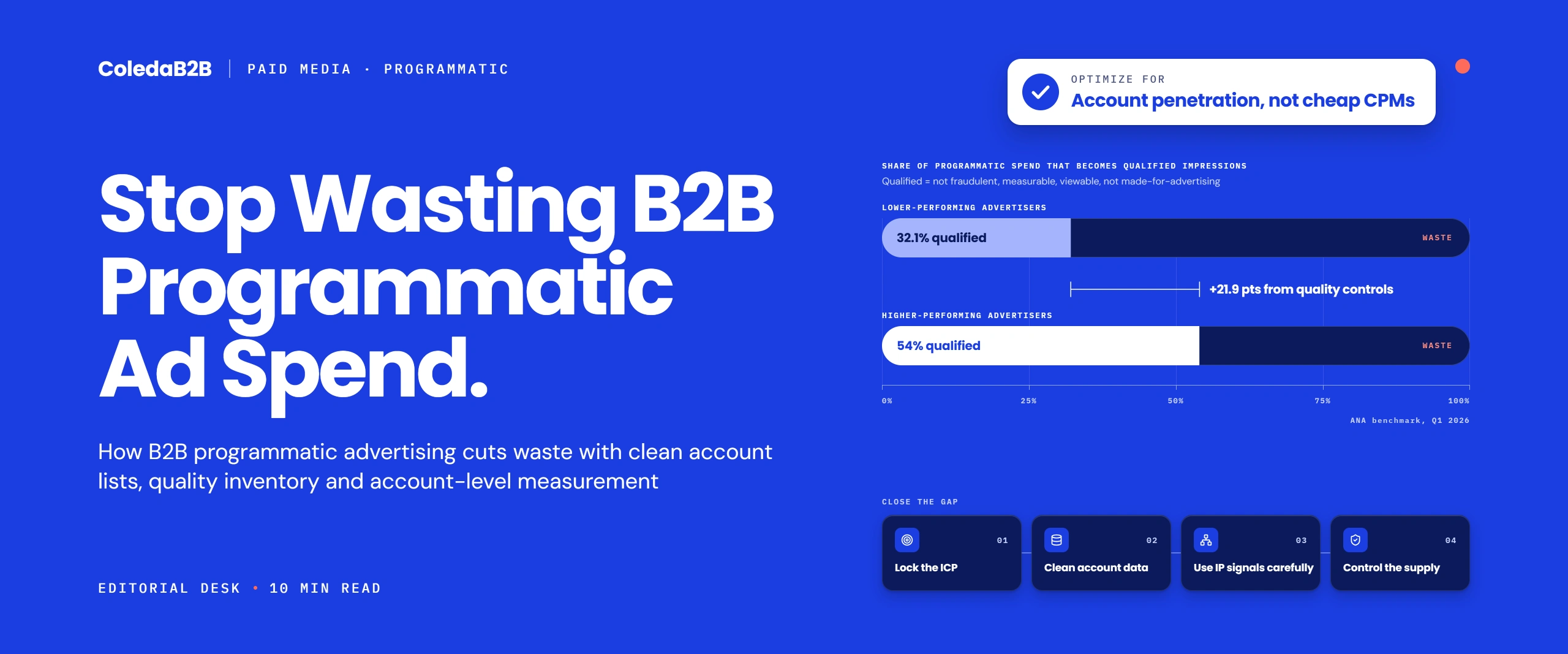
Programmatic supply chains also contain measurable inefficiencies. The Association of National Advertisers’ Q1 2026 benchmark found that higher-performing advertisers converted 54% of programmatic spend into qualified impressions, compared with 32.1% among the lower-performing group. The benchmark defines qualified impressions around factors including fraud, measurability, viewability, and made-for-advertising inventory.
That creates an important operating principle:
Do not optimize the campaign simply because the platform says it is getting cheaper. Optimize it because the media is becoming more useful.
A $3 CPM is not efficient if the impression reaches an irrelevant audience. A higher CPM can be justified when the inventory, audience, account coverage, and measurement are substantially better.
The B2B Programmatic Advertising Waste Elimination Playbook
A practical B2B programmatic strategy should control waste at several points in the campaign, not only after the first report arrives.
1. Lock Down the ICP
Begin with the accounts, not the creative.
Build a clean target account list and establish clear inclusion criteria. If the campaign is designed to support an ABM motion, the advertising audience should reflect the same account priorities used by sales.
Avoid adding broad audiences simply to increase scale unless there is a deliberate awareness objective behind the expansion.
The tighter the definition at the beginning, the easier it becomes to understand whether paid media is actually penetrating the intended market.
2. Clean the Account Data
Targeting quality depends on data quality.
Company names, domains, locations, subsidiaries, and other identifiers need to be normalized before they become a media audience. Duplicate accounts or outdated domains can create wasted delivery and make account-level reporting unreliable.
This is often overlooked because it happens before the campaign reaches the media platform. Yet a poorly maintained account list can undermine everything that follows.
For an agency managing B2B programmatic advertising, audience preparation should therefore be treated as part of campaign execution, not administrative work.
3. Use IP-Based Targeting Carefully
IP-based targeting can help connect digital advertising with specific business locations, but it should not be treated as a perfect identity layer.
Corporate networks, remote work, shared facilities, dynamic IPs, privacy controls, and changing network infrastructure can affect accuracy. For that reason, IP signals work best as one part of a broader account-targeting strategy rather than the only targeting mechanism.
The practical objective is account penetration, not pretending that every impression can be tied perfectly to one employee.
4. Control the Supply
Audience precision is only half of the equation.
Your ads can be aimed at the right account and still appear in poor-quality environments. Supply-path controls, publisher selection, viewability requirements, fraud protection, brand-safety controls, and curated inventory all influence how much of the media budget creates useful exposure.
ANA’s latest transparency research continues to show a strong relationship between media quality and programmatic efficiency. Its Q1 2026 benchmark found a substantial performance gap between advertisers with stronger quality controls and those with weaker execution.
This is why a B2B campaign should not simply ask, “How many impressions did we buy?”
It should also ask, “Where did those impressions occur, and were they worth buying?”
Use Display and Native Advertising for Different Jobs
Display advertising remains useful when the objective is consistent account visibility. It can reinforce brand recognition, support a campaign theme, and keep a company visible while buyers research solutions over time.
Native advertising B2B can serve a different role. Its format can make educational content, research, reports, and thought leadership feel more connected to the surrounding publisher experience.
Neither format should exist simply to increase impression volume.
For example, an account showing early engagement with a solution category may receive educational content first. Later, stronger engagement can justify a more product-focused asset or a sales-oriented call to action.
That creates a media sequence rather than a collection of unrelated advertisements.
Make Programmatic Support Sales, Not Compete With It
Programmatic becomes more valuable when marketing and sales use the same account strategy.
Suppose sales is actively working a group of strategic accounts. Marketing can use programmatic advertising to reinforce visibility around those companies while sales conducts direct outreach.
Sales then has another layer of context:
- Which target accounts are receiving campaign exposure?
- Which accounts are showing engagement?
- Which accounts have increased activity?
- Which accounts remain untouched?
- Which accounts should be excluded because they have already converted or entered another campaign?
That information can influence outreach timing and messaging without pretending that an ad impression alone proves buying intent.
This is where account-based advertising becomes more useful than broad B2B audience buying. Paid media becomes one part of an account strategy rather than an isolated media channel.
Measure Account Penetration, Not Just Media Volume
A B2B programmatic campaign should still track standard media metrics. CPM, reach, frequency, viewability, clicks, and conversions help diagnose delivery.
However, account-based campaigns need another layer of measurement.
Look at:
Target account coverage: How many priority accounts received meaningful exposure?
Account penetration: Are multiple relevant people or buying groups within those accounts being reached?
Engagement: Which target accounts are interacting with the campaign?
Sales alignment: Are exposed accounts also receiving relevant sales activity?
Pipeline movement: Do engaged accounts progress into meaningful sales stages?
This changes the conversation with leadership. Instead of reporting that the campaign generated millions of impressions, the team can explain how effectively paid media supported the accounts that matter to revenue.
Build Around the Sales Motion
Programmatic should not operate on a separate calendar from the rest of demand generation.
If sales is opening conversations with a target account, advertising can reinforce the same positioning. If an account enters an active opportunity, messaging can change. If an opportunity closes, that account can move into a customer marketing track rather than continuing to receive acquisition messaging.
Likewise, accounts that show no meaningful engagement should not consume budget indefinitely.
This requires coordination between the target account list, campaign audience, CRM, media platform, creative, and reporting layer. The more closely those systems connect, the easier it becomes to control frequency, exclusions, audience movement, and campaign priorities.
Where Programmatic Waste Usually Hides
Waste is rarely caused by one dramatic mistake. It tends to accumulate through small decisions that look reasonable in isolation.
A campaign may have a large audience because the team wants scale. Another segment gets added because delivery is slow. A low-cost publisher is retained because its CPM looks attractive. Frequency rises because the campaign is trying to improve recall. Broad retargeting remains active after an account has moved into a sales conversation.
Individually, each decision can appear harmless.
Together, they can move the campaign away from its original purpose.
A stronger operating model regularly asks:
Is this impression helping us penetrate a priority account, or are we buying it because the platform can deliver it cheaply?
That question should influence targeting, supply, creative, budget allocation, and optimization.
When to Expand the Audience
Precision does not mean keeping the audience artificially small forever.
If a campaign reaches the intended accounts but cannot generate enough meaningful exposure, expand deliberately. Test adjacent accounts, related industries, additional buying roles, or broader geographic coverage based on the campaign objective.
However, expansion should be measurable.
Keep the original ICP audience as a benchmark. Then compare the broader segment against it for account quality, engagement, cost, and downstream outcomes.
That gives the team a controlled way to increase scale without losing sight of who the campaign was designed to reach.
The Practical B2B Programmatic Advertising Checklist
Before launching a campaign, confirm that you can answer these questions:
- Is the target account list clean and current?
- Are the ICP criteria clear?
- Are account identifiers mapped correctly?
- Are IP and other audience signals being used with realistic expectations?
- Are low-quality inventory and unsuitable environments excluded?
- Does the creative match the buying stage?
- Are display and native placements serving a defined purpose?
- Are sales and marketing using the same account priorities?
- Can you measure account coverage and engagement?
- Do you have clear rules for exclusions, frequency, and audience expansion?
If several answers are unclear, increasing the media budget is unlikely to solve the underlying problem.
Programmatic Should Make the Account Strategy Stronger
B2B programmatic advertising works best when it is treated as an account access system rather than an impression delivery system.
Start with the ICP. Build and clean the target account list. Apply precise audience controls. Use IP-based signals carefully. Curate the supply. Match creative to the buying context. Then connect media exposure with sales activity and account-level measurement.
The technology can automate the buying process, but it cannot decide which accounts deserve your budget.
That decision comes from strategy.
For B2B marketers, the real opportunity is not simply reaching more people. It is reducing the distance between media spend and the accounts your sales team actually wants to win.
FAQs:
B2B programmatic advertising uses automated technology to purchase digital advertising inventory and deliver ads to defined business audiences. A strong B2B approach focuses on target accounts, ICP criteria, quality inventory, and account-level measurement rather than broad reach alone.
Real-time bidding allows an ad impression to be evaluated and purchased through an automated auction as the impression becomes available. The buying system uses available audience, inventory, and campaign criteria to determine whether that impression is worth bidding on.
Account-based advertising focuses paid media on specific companies rather than relying only on broad audience categories. It is commonly used alongside ABM programs to increase visibility within selected target accounts.
IP targeting can help associate advertising activity with business locations or networks. However, it has limitations and should be combined with other account and audience signals rather than treated as a perfect identifier for individual buyers.
Along with CPM, reach, frequency, viewability, clicks, and conversions, B2B marketers should evaluate target account coverage, account engagement, buying-group penetration, sales activity, and pipeline progression.
Yes. Programmatic advertising can support ABM by keeping selected accounts exposed to relevant messaging while sales and other marketing channels engage those accounts. Its value increases when media targeting, CRM data, sales activity, and measurement are connected.
Start with a clean target account list, apply tight audience controls, manage supply quality, monitor invalid and non-viewable impressions, control frequency, exclude irrelevant or converted accounts, and measure performance at the account level instead of relying only on impression volume.